




Get Ed Crooks' Energy Pulse in your inbox every week
Aiming for the big prize in US unconventional oil and gas
The Trump administration has set a goal of doubling recovery from unconventional resources. The industry is already heading in that direction
1 minute read

Ed Crooks
Vice Chair Americas and host of Energy Gang podcast

Ed Crooks
Vice Chair Americas and host of Energy Gang podcast
Ed examines the forces shaping the energy industry globally.
Latest articles by Ed
-
Opinion
Aiming for the big prize in US unconventional oil and gas
-
Opinion
California’s grid under pressure: affordability, AI, and the future of electricity markets
-
Opinion
What could change in Venezuela mean for oil production?
-
Opinion
What happened at COP30?
-
The Edge
Five key takeaways from COP30
-
Opinion
Sodium-ion batteries enter energy storage market
The US shale gas and tight oil revolution is rightly hailed as a triumph for the industry. What is often less widely appreciated is the key role the government played in laying the foundations for the crucial commercial breakthroughs in hydraulic fracturing and horizontal drilling.
As set out in a Breakthrough Institute paper from 2012, contributory factors included financial support for R&D and pilot projects, tax credits for innovative operations, and oilfield technologies first developed in government laboratories. Those strategies, in some cases pursued over decades, were critical for making the eventual shale boom possible.
Now the Trump administration is talking to the US industry about opening a new chapter in the story of shale. It may not be quite as dramatic as the initial breakthroughs in unconventional resources, but it would have almost equally wide-ranging implications.
Speaking at a meeting of the National Petroleum Council (NPC) last week, Kyle Haustveit, the assistant secretary of energy and head of the department’s newly renamed Hydrocarbons and Geothermal Energy Office, set out its policy priorities and goals for the next few years. The first item on his list was doubling recovery factors for US unconventional resources.
“Today for oil reservoirs we recover roughly 10% of the oil in place,” he said. “We can repeat the shale revolution with the resource we’ve already characterised, the wells we’ve already drilled, through the infrastructure that’s been built.”
It was not an idle pledge from an uninformed politician. Assistant Secretary Haustveit is a professional petroleum engineer who before going into government worked at Devon Energy in various technical and leadership roles. He led teams developing and commercialising diagnostic techniques that are used to optimise hydraulic fracturing and resource development around the world. He is undeniably qualified to lead a government effort to work with the industry to improve those operations.
The 10% average recovery factor for US tight oil is low by the standards of the global industry. Conventional oil recovery factors are typically around 30% to 35% of the original oil in place, and can get as high as 60% to 70% with Enhanced Oil Recovery and advanced secondary or tertiary recovery methods such as gas injection and chemical flooding.
As Haustveit said at the NPC meeting, his goal of improving recovery in unconventionals is well aligned with the latest thinking in the US industry. This year there has been a noticeable upturn in operators’ interest in raising recovery factors.
Darren Woods, chief executive of ExxonMobil, was one of the first industry leaders to highlight this point. He said at a conference back in 2023 that he had set a challenge to the company to double recovery factors, and to find technologies that could unlock that.
This week, the company gave more details on how it was rising to that challenge. In an investor presentation published this week, ExxonMobil said its “deep technology pipeline provides line of sight to doubling recovery and growth beyond 2030” in the Permian Basin. Examples of technologies already being used to increase recovery include AI for development planning, wells with extended lateral lengths of over 20,000 feet, and the company’s proprietary lightweight proppant. The company said its total number of new technologies for the Permian, including innovations in the pipeline but not yet in commercial deployment, is more than 40.
Chevron has similarly been emphasising its commitment to improving recovery with its own proprietary technologies. Mike Wirth, its chief executive, said in an interview in October that "the biggest opportunity is to recover more of the molecules that are in the ground”.
Its recent investor presentation, published last month, highlighted the role of the company’s advanced chemical treatments and reservoir modelling in boosting recovery factors.
With the two US Majors now firmly focused on improving recovery, and the rest of the tight oil industry heading in the same direction, the Department of Energy can expect to find plenty of enthusiastic partners willing to work on making progress towards its goal.
The Wood Mackenzie view
The US tight oil industry is maturing. Wood Mackenzie is forecasting that US Lower 48 onshore oil production will reach a plateau in the early 2030s and begin to decline steadily in the second half of that decade. And as in any other maturing region, operators are becoming increasingly focused on recovery factors as the key to sustaining production profiles for the long term.
“When people in the industry or the government talk about doubling recovery, that does not necessarily mean doubling production rates,” says Robert Clarke, Wood Mackenzie’s vice president of Upstream research.
“It’s about how you can sustain production at around its current levels for as long as possible, for as low a cost as possible.”
Over the past 10 years, productivity for US tight oil wells, as measured by expected ultimate recovery per lateral foot, has been flat or slightly falling in key plays, including the Wolfcamp in Texas and New Mexico and the Bakken in North Dakota.
But doubling overall recovery does not necessarily mean doubling the production from each well. Instead, it is most likely to mean a combination of productivity gains and cost reductions that make it commercially viable to drill more wells, particularly in lower-quality acreage, to double recovery from the entire basin.
For the industry as a whole, improving recovery is more likely to extend production for longer than to deliver a short-term surge in output. It could nevertheless be highly significant for the US economy and national security.
Wood Mackenzie’s forecasts show oil demand is set to be highly resilient out to 2050 and beyond. Other forecasters have even more bullish expectations. On our forecasts, the OPEC+ countries are projected to increase their share of the world oil market steadily from around 2030 onwards. Higher tight oil recovery rates would help the US defend its market share for decades to come.
Wood Mackenzie’s Clarke says that the administration’s goal of doubling recovery factors for unconventional resources is ambitious and cannot be achieved fully in the short term. But recovery is an issue that will be increasingly important for the industry.
The prize is immense. Doubling Lower 48 tight oil recovery factors would unlock billions of barrels of oil already known to be in the ground. A government-backed effort to support R&D and incentivise innovation in US tight oil could pay big dividends over time.
“Doubling is a big goal, and a big ask for the industry,” Clarke says. “But conceptually, the idea of having better downhole engineering and better cost control is completely realistic. There will be companies that will be successful with this approach.”
For companies operating in US tight oil, it is not really a question of whether they should spend time and resources to pursue improved recovery. It is a strategic imperative that they do.
In brief
The US seized a tanker carrying Venezuelan oil, in the latest escalation of tensions between the two countries. The tanker Skipper, which is believed to have carried cargoes of crude from both Venezuela and Iran, in violation of international sanctions, was boarded by US forces on Wednesday. Kristi Noem, the US Homeland Security Secretary, said President Donald Trump had ordered the seizure of the ship to ensure that the US was “pushing back on a regime that is systematically covering and flooding our country with deadly drugs”.
Reuters reported on Thursday that the US was preparing to seize more tankers off the coast of Venezuela. On the same day, the US Treasury announced new sanctions on six more ships accused of carrying Venezuelan oil. Speculation has been growing that the US could use military action to oust the government of President Nicolas Maduro.
The US government held a lease sale for the Gulf of America (Gulf of Mexico), the first since sales were mandated by the budget legislation passed in July. There were 26 companies placing 219 bids on 181 blocks, generating about US$300 million in high bids. Wood Mackenzie analysts said overall activity was in line with their expectations, but muted compared to the previous lease sale in 2023. Total bids were down 14.5%. BP, Chevron and Woodside had the highest value of winning bids. For more details, look out for Wood Mackenzie’s full analysis.
In the latest sign of the AI industry’s frenetic search for electricity supply, the supersonic airliner company Boom has announced it has US$1.25 billion of orders for its new Superpower gas turbines, based on the jet engines it has designed for its aircraft. Data centre developer Crusoe has placed an order for 29 Superpower units, with a total capacity of about 1.21 gigawatts. Boom plans to announce the location of its turbine factory and begin testing next year, and deliver the first units to Crusoe in 2027.
Other views
Conversation starters: Five energy charts to get you talking – Malcolm Forbes-Cable
Southeast Asian data-centre power demand is set to explode – Yanqi Cao and Alex Whitworth
Big Beautiful Gulf 1 lease sale shows "targeted" approach in new leasing era
US adds 11.7 GW of new solar capacity in Q3, third largest quarter on record
European battery storage deployment expected to grow 45% in 2025
What defined gas trading in 2025: five moments that mattered – David Lewis
Wood Mackenzie highlights four US Lower 48 themes to look for in 2026
A bolder vision for American energy – Matthew Yglesias
What’s happening to wholesale electricity prices? – Brian Potter
Quote of the week
“Newsflash: there is no correlation between data centres growing in states and higher electric prices. In fact, in many states, it’s actually the opposite. States like Texas, who have added over a hundred data centres in the last five years, have seen electric prices go down. North Dakota’s had the biggest increase in electricity demand in the last five years of any state in the country, on a percentage basis. And electric prices [there] are among the absolute lowest in the country. So what’s driving it? Some of the states, and some of even the utilities, are blaming data centres, when, in fact, they shut down reliable, dispatchable, dependable, affordable, secure baseload, and replaced it with intermittent, unreliable, highly subsidised sources of electricity.”
Doug Burgum, the US Secretary of the Interior and chairman of the National Energy Dominance Council at the White House, rejected concerns about new data centres driving up electricity bills. The cost of electricity is becoming an increasingly contentious political issue in the US.
Chart of the week
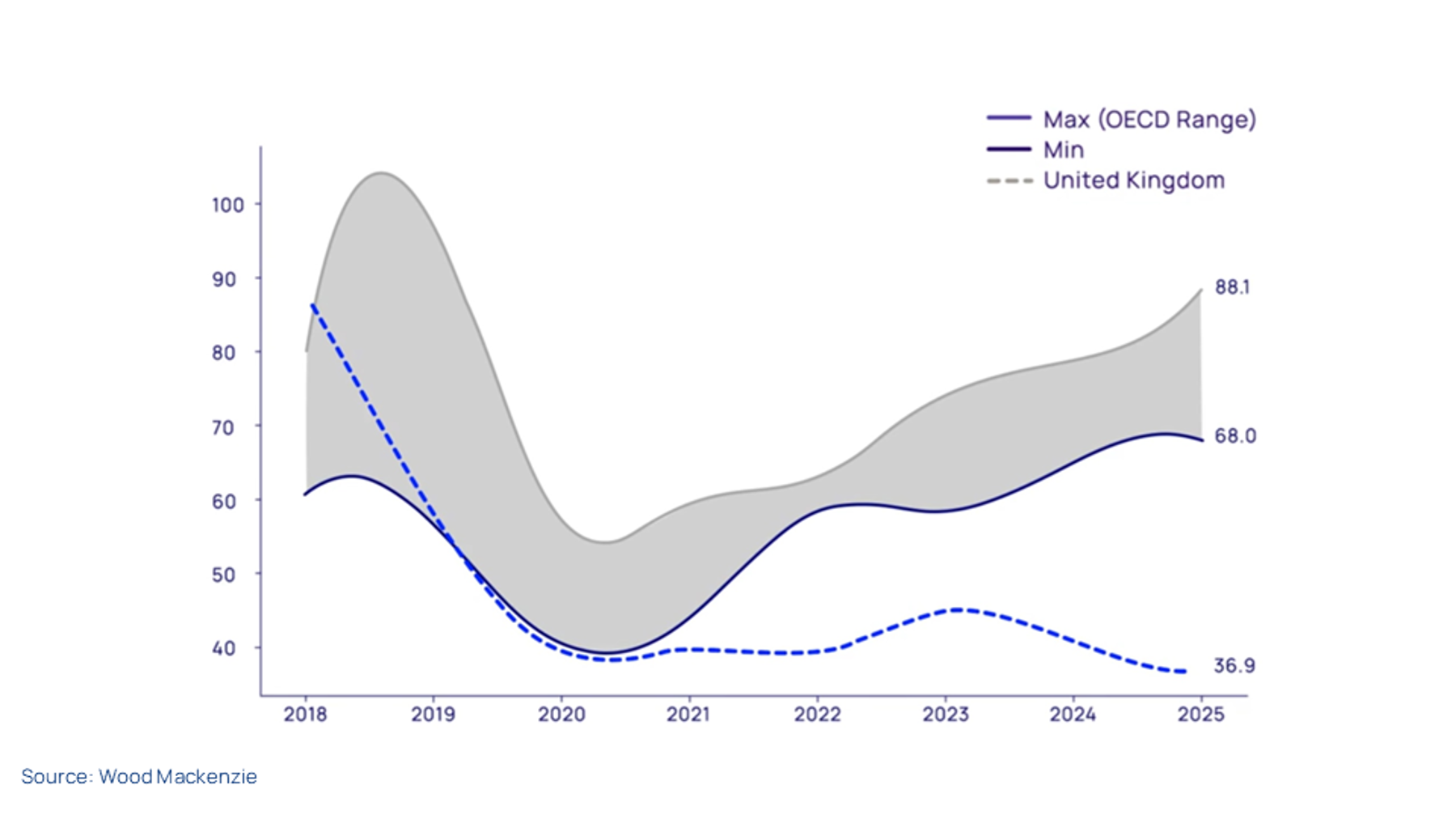
This comes from our last Horizons report of the year. Malcolm Forbes-Cable, Wood Mackenzie’s Vice President for Upstream and Carbon Management consulting, has again compiled his five most interesting charts of the year, to act as “conversation starters”. Something to discuss over the turkey and Brussels sprouts, perhaps.
This is one that I particularly liked, although it makes depressing reading for the UK. It shows the implied long-term oil price (ILTOP) given by transactions in the UK and other members of the OECD. It represents the implied Brent crude price that would set Wood Mackenzie’s valuation of the assets (defined as net present value using a 10% forward discount rate) equal to the price paid in the deal. The UK has an ILTOP significantly lower than any other OECD country, reflecting the upstream industry’s declining interest in investing there. For more detail on this, and four other fascinating charts, check out the full report.

Get The Inside Track
Ed Crooks’ Energy Pulse is featured in our weekly newsletter, the Inside Track, alongside more news and views from our global energy and natural resources experts. Sign up today via the form at the top of the page to ensure you don’t miss a thing.