




与我们分析师联系
Oil’s resilience in the energy system
What firm liquids demand means for upstream and refining
1 minute read

Simon Flowers
Chairman, Chief Analyst and author of The Edge

Simon Flowers
Chairman, Chief Analyst and author of The Edge
Simon is our Chief Analyst; he provides thought leadership on the trends and innovations shaping the energy industry.
Latest articles by Simon
-
The Edge
Oil’s resilience in the energy system
-
Opinion
Five key takeaways from our Gastech 2025 Leadership Roundtables
-
The Edge
Five key takeaways from COP30
-
The Edge
Can copper supply keep up with surging demand?
-
The Edge
ADIPEC 2025: six key takeaways
-
The Edge
Slipping climate targets and the “energy addition”

Alan Gelder
SVP Refining, Chemicals & Oil Markets

Alan Gelder
SVP Refining, Chemicals & Oil Markets
Alan is responsible for formulating our research outlook and cross-sector perspectives on the global downstream sector.
Latest articles by Alan
-
The Edge
Oil’s resilience in the energy system
-
Opinion
5 key ways to decarbonise downstream
-
Opinion
How can European refiners thrive in an uncertain world?
-
Opinion
Flight path to net zero: aviation’s fuel outlook to 2050
-
The Edge
Securing offtake for green hydrogen
-
Opinion
5 top takeaways from our APPEC 2025 briefings

Douglas Thyne
Research Director, Oil Supply

Douglas Thyne
Research Director, Oil Supply
Douglas manages our global oil supply research and forecasts.
Latest articles by Douglas
-
The Edge
Oil’s resilience in the energy system
-
Opinion
Trump’s tariff plan: implications for the future of global liquids trade
-
The Edge
Can China’s recovery turn the oil market around?
Too much supply, consequently weak prices and the inevitable response of corporates to cut costs and investment. That’s the short-term oil market narrative into 2026. Yet the outlook for oil demand beyond, certainly into the next decade, looks more robust than it has for some time, with positive implications for the entire value chain. In this, the 400th Edge – on the 10th anniversary of the first edition – our macro oils experts, Douglas Thyne and Alan Gelder, share their thoughts with me.
Why does the outlook for oil demand look firmer today?
A combination of two main factors suggests that demand will be more resilient than many had expected in the aftermath of the Paris Agreement a decade ago.
First, the war in Ukraine forced a readjustment of energy policy around the energy trilemma. Many governments have skewed policy towards energy security and affordability over sustainability, strengthening hydrocarbons’ hold on the energy market. Second – a symptom of the slow pace of the unfolding energy transition – is the modest penetration rate of electric vehicles and e-trucks in most countries, except China. That’s supporting demand for gasoline and diesel, which together constitute over half of global oil consumption.
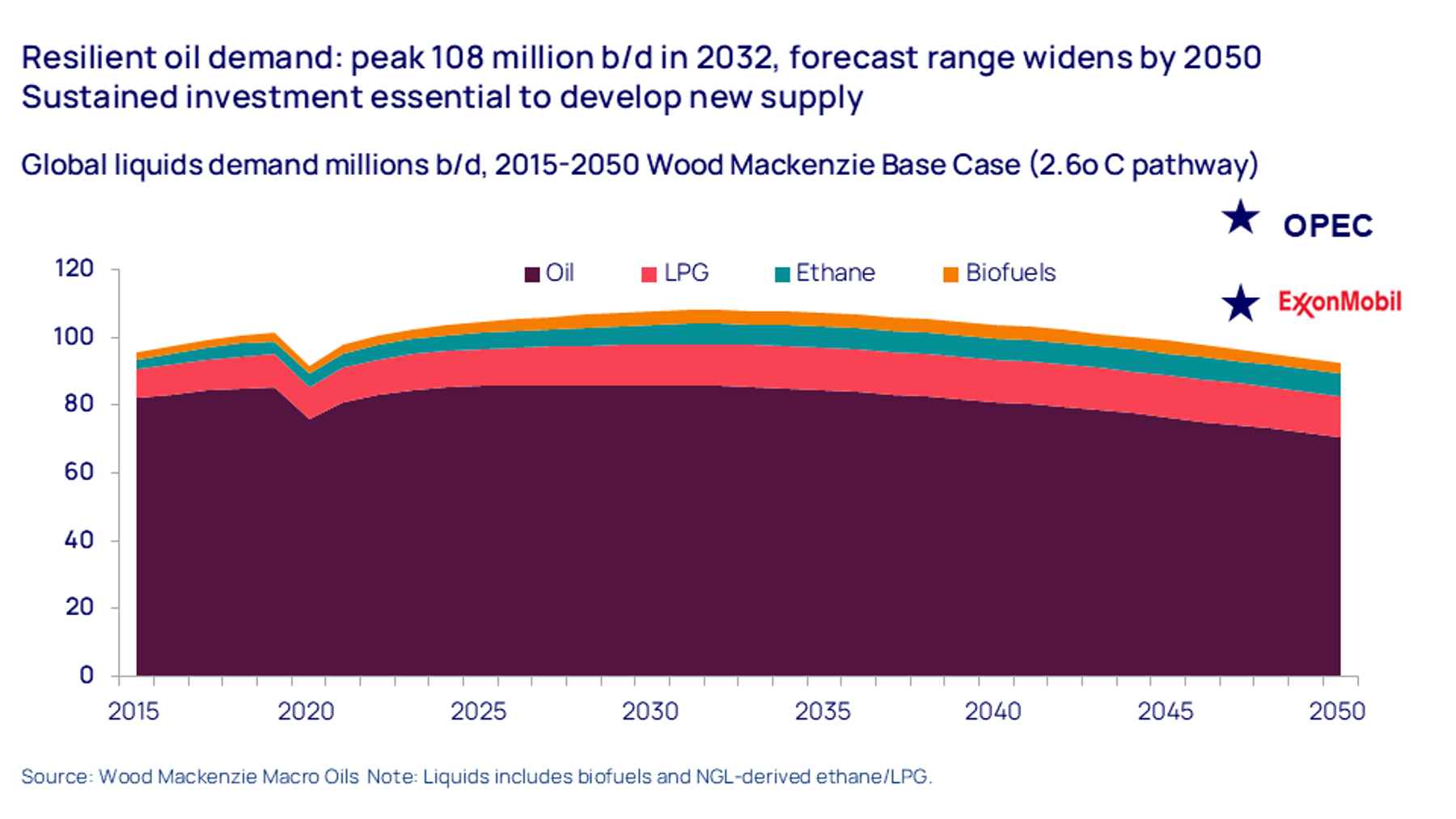
It’s all reflected in the shape of Wood Mackenzie’s latest long-term base case demand profile, a 2.6 °C warming pathway. We reduced our growth forecast after the Trump tariffs were announced, so forecast global liquids demand – that is, oil, LPGs, ethane and biofuels – at around 104.5 million b/d in 2025, only 800 kb/d higher than 2024. We expect demand continues on a growth path for the next seven years at a progressively slowing rate, reaching a peak of 108 million b/d in 2032.
Thereafter, we expect a gentle decline to 93 million b/d in 2050. The drivers behind the decline – mainly EVs and e-trucks gaining market share in transportation, along with improving efficiency in ICE vehicles – are offset by aviation and petrochemicals growth.
Our demand forecasts through the 2030s have remained largely unchanged. Others though have made material upgrades to their numbers recently and now align more closely with ours. However, a widening spread starts to emerge further out, with international oil companies (IOCs) and other sources far more bullish than Wood Mackenzie. For example, TotalEnergies projects 98 million b/d by 2050, ExxonMobil 105 million b/d, the IEA 113 million b/d (in its Current Policies Scenario) and OPEC 123 million b/d.
Where will new supply come from and what will it cost?
IOCs and national oil companies are already positioning for stronger-for-longer demand, focusing on business development to strengthen upstream portfolios to deliver the supply. The task ahead, though, gets tougher for them by the year as demand grows and existing fields decline.
We estimate the ‘supply’ gap by 2035 – the volume of new liquids the upstream industry needs to bring onstream – is just over 20 million b/d for base case demand. Achieving that will require sustained development investment of at least US$520 billion a year.
A gap of this scale can be filled at a reasonable cost, based on data in our Oil Supply Tool. Future Lower 48 drilling, new conventional projects, OPEC production growth, reserves growth, exploration and technical resource, and unconventionals such as gas-to-liquids will all contribute. The bulk of the liquids will be at relatively modest cost per barrel but a Brent price of at least US$70/bbl (real) will be needed to incentivise investment in the more expensive barrels needed to meet demand.
Should demand be even higher than in the base case, the challenge mounts. Our Delayed Energy Transition Scenario, a 3 °C pathway, suggests a supply gap of 26 million b/d in 2035, requiring at least US$90/bbl (Brent real) to incentivise investment in higher-cost barrels. The ‘ask’ will only get bigger if demand stays elevated into the 2040s and as lower-cost resource is depleted.
What does all this mean for refining?
Unlike upstream, refiners in 2025 are enjoying heady times. Global refining margins have been buoyed by high maintenance, disruption to the Russian refining system and tighter sanctions on Russia-related exports – all of which have come at the tail-end of capacity rationalisation in Europe and Japan over the last decade.
Refineries integrated with petrochemicals are leveraged to margin upside as the overcapacity in chemicals unwinds towards the end of the 2020s. Biofuel blending to meet the growing requirement for lower-emissions liquid fuels is another growth opportunity.
The main strategic challenge ahead for refiners globally, though, will be to adapt to the ongoing rise of EVs and e-trucks. As demand for road transport ebbs, earlier and faster in some markets than others, more refineries will look to export into those where gasoline and diesel demand holds up.
But the immediate outlook for refining profitability for the rest of this decade is promising. The wave of new-build capacity in China, the Middle East and Africa is coming to an end. Stronger-for-longer oil demand into the next decade points to high refinery utilisation and average global indicator margins 10% to 20% above those of the past five years (excluding the exceptional returns during 2022 and 2023 sparked by Russia’s invasion of Ukraine).

Make sure you get The Edge
Every week in The Edge, Simon Flowers curates unique insight into the hottest topics in the energy and natural resources world.